by Roy Murphy
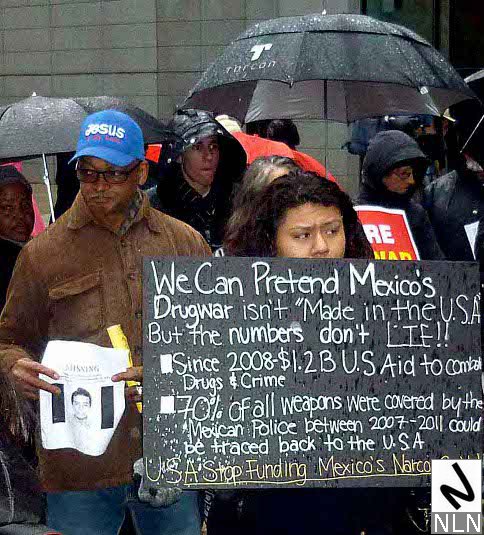
(Photo: Roy Murphy / NLN)
NEW YORK — December 5, 2014. This week saw a series of turbulent nationwide protests that escalated in volume as each protest drew on the emotions and demands of the others.
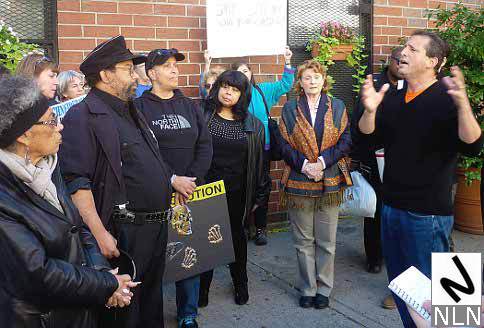
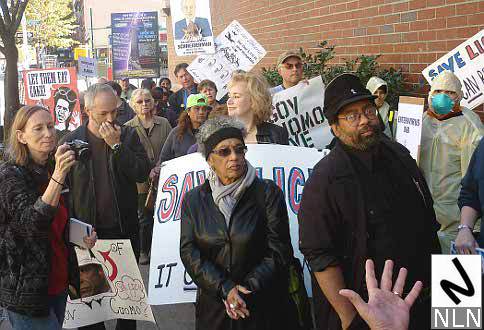
Wednesday, December 3, 2014 - A new organization, #UStired2, organized a national day of action in more than 43 cities across the United States on two days notice. It was seeking action on the 43 students from the Rural Teachers’ College in Ayotzinapa, who disappeared in Mexico on September 26, 2014.
The organization named itself when Mexico’s attorney general abruptly cut off a press conference on the missing students by saying, “Enough, I am tired.”
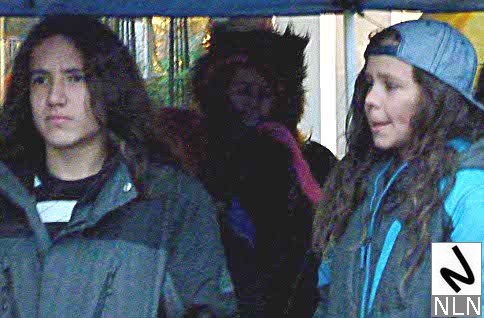
About 40 people in downtown Manhattan joined the nation-wide protests demanding a US Senate hearing on US military aid to Mexico. U.S. law obliges the U.S. government to cut off aid to security forces who violate human rights.
A speaker drew applause when he said that militarization of efforts to combat conflicts affects not just Mexico, but Colombia, Venezuela, Gaza, and Ferguson, Missouri.
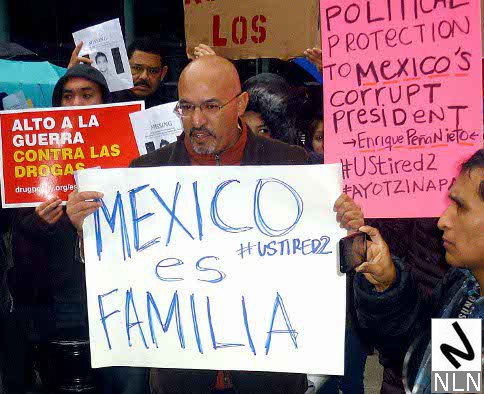
(Photo: Roy Murphy / NLN)
He said, “The 43 are not dead yet. The Mexican government wants to call them dead and close the issue. Their only crime was to demand a better life.”
#UStired2 said, “The first step in the process is to stop “Plan México,” a multi-billion dollar U.S. aid package that has done nothing to reduce drug traffic into the U.S., and has instead supported a corrupt government using the drug war as cover for a war on its own people.”
It is reported that the local mayor of Iguala in Mexico thought the students would disrupt a speech by his wife, so he ordered the police to arrest them. The police handed the students over to a local drug cartel. They haven’t been seen since.
Investigations revealed several mass graves in the area, but so far no human remains have been identified.
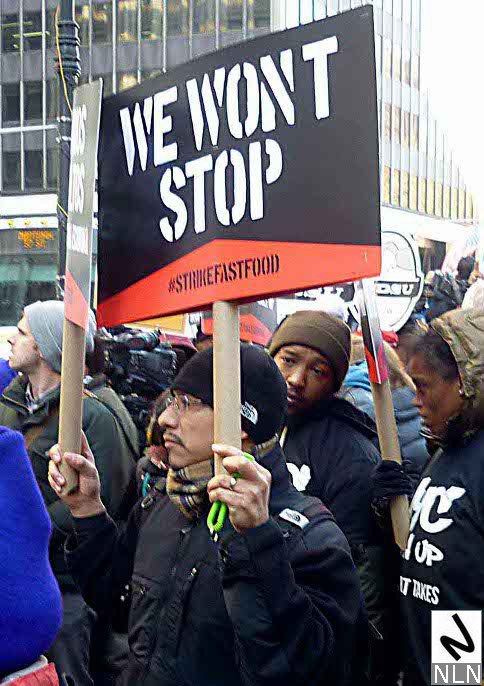
(Photo: Roy Murphy / NLN)
Thursday, December 4, 2014, midday - A diverse group of 400 gathered outside City Hall in Manhattan to support the call of fast food workers across the country for a minimum wage of $15 an hour.
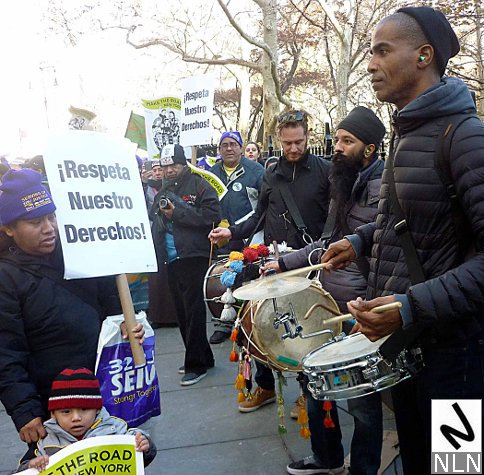
(Photo: Roy Murphy / NLN)
They were part of low-wage workers in more than 190 cities who walked off the job. Employees from discount and convenience stores, as well as workers from 10 of the nation’s busiest airports, joined in.
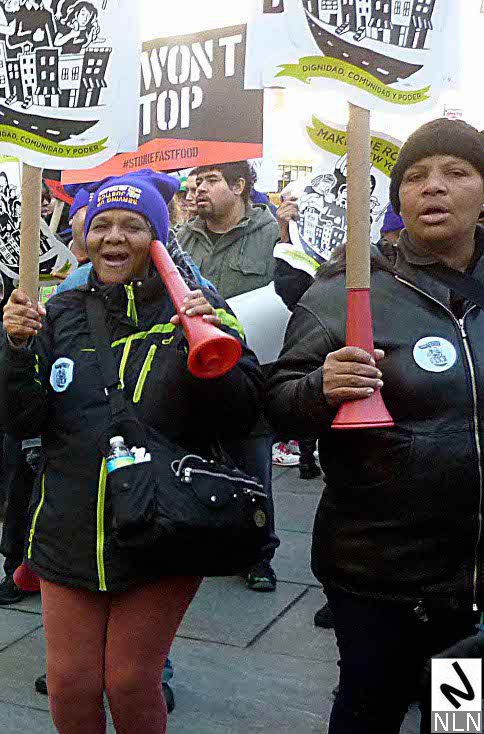
(Photo: Roy Murphy / NLN)
Protesting workers in New York were diverse in their age, gender and race — and concerned about issues extending beyond the workplace. They held a four minute and 30 second silence in remembrance of Michael Brown, who was left dead in a pool of blood, uncovered, on the public street in Ferguson for four and a half hours before police moved the body.
One speaker said, “If we don’t do it together, no one will have justice. And we demand justice!”
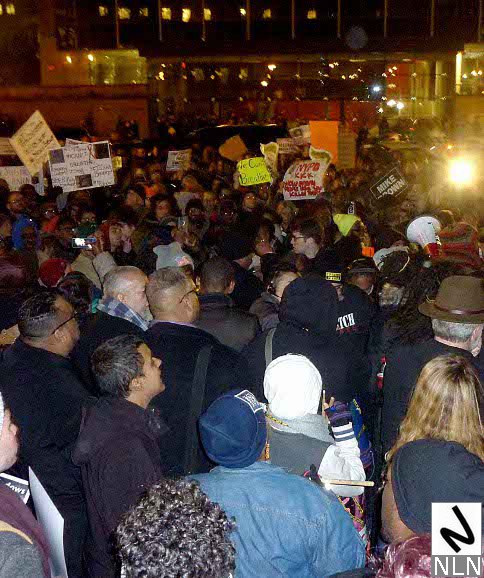
(Photo: Roy Murphy / NLN)
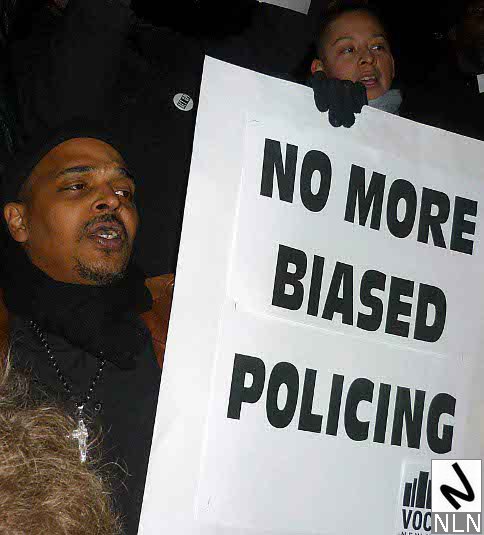
Thursday, December 4, 2014, evening - Thursday night, more than 7,000 gathered in Foley Square in downtown Manhattan, and there were smaller protests elsewhere in the city and other boroughs. They were protesting yet another grand jury failure to indict a police officer who killed an unarmed African American man.
Similar large protests were held in many other major cities across America.
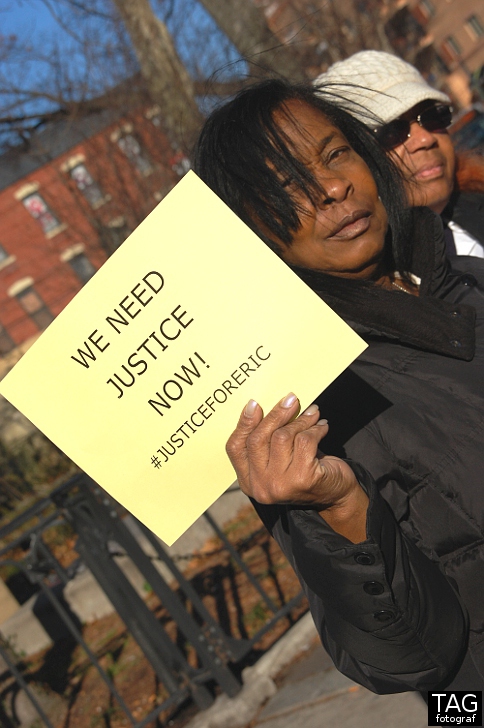
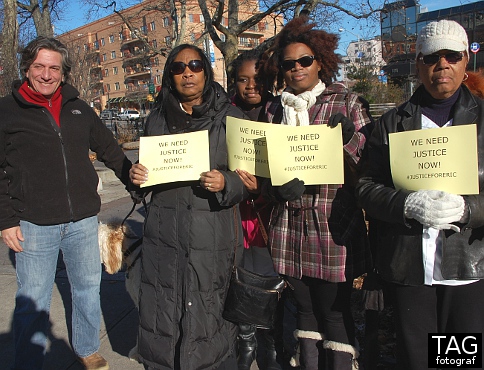
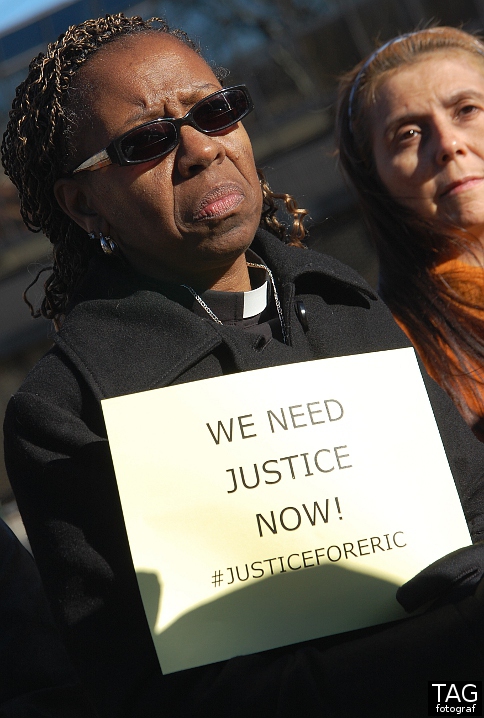
The previous day a grand jury refused to indict the police officer responsible for the death of Eric Garner. Garner died after being placed in an apparent chokehold by police in Staten Island. The decision came a week after the grand jury in Ferguson, Missouri, made the same decision following the shooting of Michael Brown. In both cases the victims were African American — and the police officers were white.
(Photo: Roy Murphy / NLN)
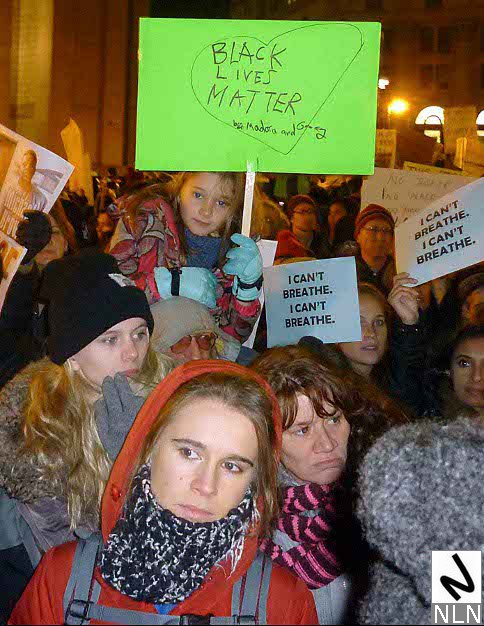
The Foley Square crowd was made up of all sorts - all races, all ages, all walks of life. After the rally, many went to the Manhattan Bridge and the West Side Highway, temporarily shutting them down.
(Photo: Roy Murphy / NLN)
Police arrested over 200. The rallies in New York and elsewhere were larger and more numerous than the previous night when the Garner decision was announced.
One of the new strategies employed by protestors is a spontaneous redirection of their efforts. They arrived at the Hudson Tunnel and found it blocked by police, so they immediately went to the West Side Highway. Or they suddenly gathered in Times Square. Instead of going where the police department allows them so they can be hemmed in and “controlled,” they exercise their right of peaceful assembly wherever they can. Some observors say they change direction so rapidly that even social media cannot keep up.
Huffington Post posted all of Eric Garner’s last words, recorded by a bystander, as the full headline of its lead story on the protests:
“Get away for what? Every time you see me, you want to mess with me. I’m tired of it.
It stops today.
Why would you…? Everyone standing here will tell you I didn’t do nothing. I did not sell nothing. Because every time you see me, you want to harass me. You want to stop me selling cigarettes. I’m minding my business, officer, I’m minding my business. Please just leave me alone.
I told you the last time, please just leave me alone. please please, don’t touch me. Do not touch me.
I can’t breathe.
I can’t breathe.
I can’t breathe.
I can’t breathe.
I can’t breathe.
I can’t breathe.
I can’t breathe.
I can’t breathe.
I can’t breathe.
I can’t breathe.
I can’t breathe.”
Roy Murphy is a regular contributor to NLN and a member of the National Writers Union, UAW Local 1981




 Protestors on the steps of Manhattan’s State Supreme Court
 Zephyr Teachout addressing the protesters
 Bethany and Rufus performing at the protest