Posted by TAG - November 15, 2012 | News


Electrical workers from DTE Energy (Detroit) – working on Staten Island
(Photo: Thomas Altfather Good / NLN)

 
STATEN ISLAND, N.Y. — November 15, 2012. Earlier today, this reporter spotted a group of electrical workers standing near their truck — not an unusual sight for New York City, except that these men were from Detroit’s DTE Energy.

 
I introduced myself and took a couple of pictures. The men asked if I would be putting the photos on the internet. I said yes and gave out my business card — which prompted a few comments, my favorite being, “United Auto Workers, that’s what I’m talking about!”

 
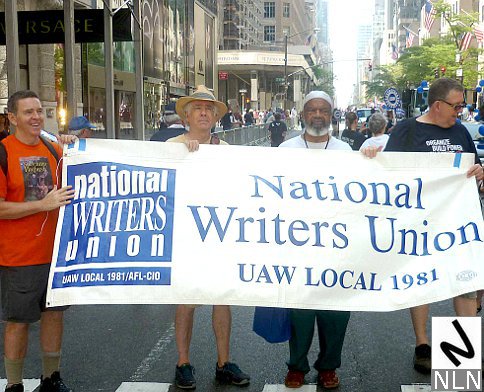
I explained that the National Writers Union is Local 1981 of the UAW, hence my union affiliation. It turned out that some of the IBEW workers had been UAW at one time. I mentioned that I still have friends and family in Local 12, in Toledo, not far from the Motor City — and thanked the guys for coming to the aid of a battered New York. Our friends from Michigan said they expected to be going home soon. I wished them well and walked away smiling — the first time I’d worn a smile in what seemed a very long time.

 
There are electrical workers from all across the country in Staten Island, working to restore power as I type. I can only say that, as a Staten Islander, I am grateful to them all — and to my new friends from DTE Energy I’d like to add, “Thank You, Detroit!”


A fellow worker from the Motor City.
(Photo: Thomas Altfather Good / NLN)


Volunteers from the University of Maryland moving supplies in Midland Beach.
(Photo: Thomas Good / NLN)


STATEN ISLAND, N.Y. — November 10, 2012. Inside “Zone A” — the Hurricane Sandy evacuation zone — recovery efforts are well underway but volunteers far outnumber other responders.


Soldiers go door to door on dusty, mud covered roads.
(Photo: Thomas Good / NLN)

 
The streets are paved but you wouldn’t know it. Walking down Quincy Avenue in Midland Beach is like venturing down a back country road. It’s muddy, bumpy, and when a vehicle passes, dusty. A blue house on the west side of the road has a bright purple portable toilet stall next to it. Sanitation is a problem, there is no electricity, and the blue house was originally on the opposite side of the road. Sandy ripped it off its foundation and moved it across the street. At night it sits there, forlorn and condemned, beneath the shadows cast by gas-powered portable street lights. And yet there is a bright spot in all of this — a very bright, multicolored, spot: dozens of volunteers dot the landscape. Volunteers clad in color-coordinated t-shirts can be seen knocking on doors, doing demolition, pulling trash out of homes and bringing survivors food, cleaning supplies — and hope.


Quincy Avenue: this house was originally on the other side of the street.
(Photo: Thomas Good / NLN)

 
The hope volunteers are delivering is a valuable commodity. Con Edison, FEMA, and the Red Cross are nowhere to be seen. Residents busily engaged in removing debris from their battered homes laugh derisively whenever the subject of restoring power arises.

 
“Thank you Con Ed,” one man said, holding up a city-issued flier promising electricity.

 
“Is that your electric bill?” his neighbor asked.


A local homeowner mockingly displays a notice promising electricity.
(Photo: Thomas Good / NLN)

 
Nearby, roped off with yellow caution tape, is the shattered home of one James Rossi, an 85-year-old Midland Beach resident who didn’t make it out alive. There is a makeshift memorial to “Jimmy” on his front door and some seven day candles on the stoop. Hearing the victim’s story, one young volunteer, a journalism student, said, “Stop, I’m going to cry…”


The final resting place of Jimmy Rossi, 85-years-old.
(Photo: Thomas Good / NLN)

 
And yet, in the middle of catastrophe, hope has returned to Midland Beach — seemingly coming out of nowhere. A group of dedicated organizers, an ad hoc organization called the Ocean Breeze Relief Angels, are parked on Quincy Avenue, giving out cups of coffee and work assignments to young volunteers.

 
One group of young workers drove up to Staten Island from the University of Maryland. Clad in Terrapin red sweatshirts and jackets, the volunteers fanned out across the neighborhood. The Terps, as they are known, brought bleach and garbage bags to Islanders struggling to clear their homes of mud and debris. They made lists of those people who had no means of preparing hot dinners, and promised to have pizzas delivered later that evening.


The clothing distribution area in battered Midland Beach.
(Photo: Thomas Good / NLN)

 
As the Terps made their presence known a group of yellow-clad Mormons from Reading, Pennsylvania, cleared homes found abandoned. Sanitation workers, using bull dozers and dump trucks, hauled away huge debris piles. The occasional garbage truck came by, its crew loading debris into the hopper. Overhead an Army helicopter passed by, a soldier leaning out one of the helo’s windows, surveying the recovery site. And a short distance away, Port Authority Police gave out supplies — bleach, water, and self-heating meals — to anyone in need. Massive piles of clothing filled the grassy strip that runs parallel to Father Capodanno Boulevard.


A Mormon from Reading, Pennsylvania, knocking on doors.
(Photo: Thomas Good / NLN)

 
Just north of Quincy Avenue, outside South Beach Psychiatric Center — now serving as the landing zone for the Army helo — the sidewalk was visible: resting at the bottom of a large sinkhole. A short distance away the South Beach boardwalk parking lot was full of cars relocated by police — cars that had been rendered inoperable by the storm surge. Some looked almost new, others had fogged windows and seaweed and debris littering their interiors. Opposite the lot, a shattered home sat, one of its walls missing. A toilet was visible from the street.


London Calling: Hannah, a volunteer from the UK, handling logistics.
(Photo: Thomas Good / NLN)

 
On Olympia Boulevard, a main artery that branches off of South Beach’s Sand Lane, a man approached this reporter and asked, “Are you FEMA?” I identified myself as press and the distraught man begged me to tell people that he has had no power since the storm — despite the fact that he and his neighbors reside next to the Crystal Ballroom, a catering hall that had power restored almost immediately. The man refused to speak on camera but begged, “Please tell people, we need power…”


An abandoned playground, near the South Beach boardwalk.
(Photo: Thomas Good / NLN)

 
Further down the boulevard two members of a group organized by the New York State Nurses Association asked me if I had seen the rest of their group. I said no but thanked them for their service. As the volunteers reversed direction, looking for their colleagues, a Red Cross van drove past. It was the first Red Cross vehicle I had seen all day.


The spirit of New York on display in South Beach, Staten Island
(Photo: Thomas Good / NLN)

 
A few blocks away, I surveyed my old neighborhood, as I approached an apartment I once called home. I was concerned that my old landlord’s family, who had treated me like royalty, might not be okay. I found Marie, my former landlord’s daughter, and her husband Rich — covered in bleach, cleaning their home. It had been 22 years since the last time I saw them. We hugged, fought back tears, and talked about our kids — and the devastation to our beloved South Beach neighborhood. I took one last shot of the day, promising Marie that I would not print it. And so I won’t. But it’s a picture of weariness, resilience — and Hope.


View Photos/Videos From The Event…


“The Myth Of Global Warming”
(Photo: Thomas Altfather Good / NLN)

 
NEW YORK — November 11, 2012. In last two years New York City has experienced two hurricanes and two Autumn blizzards — perhaps it’s time we changed the hurricane naming conventions?

 
Hurricane Irene, Hurricane Sandy — these names sound so benign and quaint. Given that global warming has impacted the frequency and severity of major storms — assuming that the “Myth of Global Warming” hypothesis advanced by creationists doesn’t fly any longer with reasonable people — perhaps its time we gave recognition to those responsible. Submitted for your consideration, some possible names for future storms: Hurricane BP, Hurricane Chevron, Hurricane Exxon, Hurricane Shell. This naming convention could be augmented to include individuals who merit recognition: Hurricane Adelson, Hurricane Cheney, and even Hurricane Koch – which could be singular or plural. With the number of storms increasing we may soon reach Hurricane W — and beyond.

Posted by TAG - November 6, 2012 | News


The “John B. Caddell,” a tanker ship, run aground by Hurricane Sandy in the Clifton section of Staten Island.
(Photo: Thomas Altfather Good / NLN)


NEW YORK — November 6, 2012. Global climate change increased the power and fury of Hurricane Sandy, according to Environmental Defense Fund Chief Scientist Steve Hamburg.


A tree falls in Brooklyn…
(Photo: Ed Hedemann / NLN)

 
The EDF is a non-profit which “Takes on the most urgent environmental threats to the climate, oceans, ecosystems and people’s health,” according to its website. Hamburg said global warming affects the ocean waters, changes in the moisture of the atmosphere and changing energy patterns — as warming in the artic affects patterns of cold air in the atmosphere. In turn, all of these factors made Sandy a more powerful storm, but Hamburg said Sandy wasn’t caused by climate change.


Manhattan under water.
(Photo courtesy of Daniel Millstone and Frank Mullen)

 
“We could see more of this in the future,” Hamburg said. “If you look at the characteristics of this storm, it’s what the climate research community has said will happen.”


Wall Street before the storm.
(Photo: Nigel French / NLN)

 
Ceres Spokesperson Peyton Fleming said the losses for the insurance industry add up to approximately $20 billion dollars. Ceres is an organization that mobilizes members of the business and investor community to “expand the adoption of sustainable business practices and solutions to build a healthy economy,” according to its website.


Staten Islanders waiting on line for gas to power their generators.
(Photo: Thomas Altfather Good / NLN)

 
“The estimates on the losses are double what they were a few days ago,” Fleming said. “But the broader economic impact is around $50 billion dollars.”


A police officer confronting an SUV driver – on the wrong side of the road.
(Photo: Thomas Altfather Good / NLN)

 
Fleming said the damage from storms like Sandy could impact insurance consumers across the board in higher insurance premiums.


The Hudson River during the storm.
(Photo: Nigel French / NLN)


View Photos From Hurricane Sandy


The landmark arch in St. Louis Missouri.
Missouri recently ranked near the bottom for
energy efficiency in a report issued from the
American Council for an Energy Efficient Economy
(Photo: Jason Sibert / NLN)

 
ST. LOUIS — October 15, 2012. Why does the state of Missouri rank so low on energy efficiency?

nbsp;
The American Council for an Energy Efficient Economy’s sixth annual energy efficiency report card recently ranked Missouri 43rd among states in energy efficiency. The report is compiled on the basis of the efficiency of utility programs, energy codes, transportation policies, the amount of energy produced by co-generation, state government initiative and appliance and equipment standards, said ACEEE Utilities Program Director Dan York.

 
Sierra Club Missouri Chapter President John Hickey said building codes and energy efficiency programs make a difference on the stateâ??s rankings on energy efficiency. Missouri has no state wide building codes, like the neighboring state of Illinois and most states in the union. In addition, most states update codes every three years, Hickey said. Missouri allows individual cities to set their own codes and some donâ??t update with any regular frequency.

 
Also, most states have energy efficiency programs that encourage thrift by requiring increases in efficiency on a yearly basis and Missouri fails to follow the same practices, Hickey said. Hickey also said coal plays an influence on the energy efficiency debate, as St. Louis area residents breath coal induced pollution from local plants while much of the coal burned in Missouri is mined out of state in Wyoming.

 
“We’re importing pollution and exporting jobs,” Hickey said. “We also pay the price in increased health costs from the coal pollution.”

 
Also, 25 percent of the energy produced by Ameren Missouri, a utility company which supplies the St. Louis area, is exported to areas outside of Ameren’s service area, said Hickey. The Missouri Sierra Club head said increases in energy efficiency could decrease coal pollution by allowing for some coal plants to be closed. In addition, energy efficiency would increase the health of local economy, as energy efficiency jobs are local jobs because local labor will be used to do such things as upgrade lights and replace old lights with new ones.

 
Ameren Missouri has committed to a three-year energy efficiency program which is scheduled to start in January of 2013, said Hickey. Ameren will invest 147 million in the new program, according to an Ameren press release. The press release also said the investment in efficiency represents the biggest in the state’s history. Ameren Communications Executive Lisa Manzo said all of the details of the program have not been released from to the public yet but that the program will have 11 different components aimed at both businesses and residential areas. She also said utility customers will be given an incentive to conserve and rebates will be available. Customers interested in the program can look for updates at actoutenergy.com.

 
Hickey said that Ameren has made commitments to efficiency before, but the programs haven’t been continuous. He hopes the new program will lead to a permanent investment in energy efficiency.


NEW YORK — October 9, 2012. A new film, featuring some NLN footage, and documenting voting rights in the U.S. — or lack thereof — will will be shown tomorrow at NYU’s Brennan Center for Justice.

 
Led by the NAACP, protesters took to the streets on December 10, 2011 to “Stand For Freedom.” This event was documented by NLN and found its way into Mridu Chandra’s new film, Electoral Dysfunction. The film will be shown tomorrow at the Brennan Center for Justice at NYU’s School of Law. A panel discussion will follow the screening. Chandra is an educator and filmmaker whose documentaries have aired at the Sundance Film Festival, SXSW and PBS. For more information on Electoral Dysfunction visit the Brennan Center website.


Protesters “Standing For Freedom” in 2011
(Photo: Thomas Altfather Good / NLN)


(Photo: Time Life Pictures / Getty Images [ Brittanica.com ] )

 
Environmental advocate, presidential candidate and former Washington University professor Barry Commoner passed away on September 30 in New York City.

 
Commoner was 95 and lived in the Brooklyn Heights neighborhood. A product of New York City, he was raised in Brooklyn and was trained as a biologist, earning a bachelor’s degree from Columbia and master’s and doctoral degrees from Harvard.

 
After his service as a Navy officer in World War II, Commoner taught at Washington University from 1947 to 1981. In 1966 he founded the Biology of Natural Systems at WU and moved the institution to New York’s Queens College in 1981. He served as its head until 2000.

 
Commoner believed science should be used to empower the community. His work on the effects of radioactive fallout from nuclear weapons testing from the United States and Soviet Union contributed to the Nuclear Test Ban Treaty of 1963. In the same year as that landmark treaty he and Margaret Mead founded the Scientists Institute for Public Information, which served as a tool the scientific community used to educate the public. Commoner penned books like “Science and Survival” (1966), “The Closing Circle: Man, Nature and Technology” (1971), and “The Politics of Energy” (1979) that are considered classics of the environmental movement.

 
Commoner’s biographer Michael Egan said that Barry was less of an environmentalist than “someone who was committed to improving society as a whole.”

 
St. Louis resident Dr. Danny Kohl studied under Commoner at WU as a graduate student and also served as an assistant professor in the botany department.

 
“I think his greatest legacy is that change doesn’t occur through whispering in the ears of the powerful,” Kohl said. “He wanted to get scientific information out to the public and let citizen’s groups organize for change. He felt social change came from social movements.”

 
Also among Commoner’s accomplishments are formulating four laws of ecology now covered in many textbooks: everything is related to everything else, everything must go somewhere, nature knows best, and there’s no such thing as a free lunch. Commoner blamed environmental degradation on capitalist economics in industry, agriculture, energy and transportation. He felt capitalist systems promoted profits and technological progress with no concern for environmental impact.

 
The scientist/activist took a journey into electoral politics in 1980 when he ran for the presidency on the Citizens Party ticket against Republican Ronald Reagan, Democrat Jimmy Carter and Independent John Anderson. The Citizens party stressed environmental issues. American Indian Civil Rights Activist LaDonna Harris was Commoner’s running mate. Harris remembers the rigors of running on a third party ticket. When she and Commoner travelled around the country campaigning in the 1980 election they often stayed in the homes of Citizens Party members. She said the party was started by citizens who were tired of the two-party monopoly in American politics.

 
“He [ Commoner ] taught me so much about the environment,” Harris said. “Like the things we’re doing to the environment that we don’t even realize. Barry had a real global perspective.”


(Photo: Sally Jones / PASI)

 
STATEN ISLAND, N.Y. — October 3, 2012. On the eve of the Romney-Obama debate anti-war protesters gathered outside the offices of Congressman Michael Grimm.

 
Anticipating the 11th anniversary of the U.S. war in Afghanistan, Peace Action Staten Island (PASI) members met Wednesday night to protest the continued presence there of 68,000 U.S. military troops – despite the recent withdrawal of the 33,000 “surge” troops sent in 2010. The gathering was peaceful but spirited, and passersby received hand-out information and invitations to more observances this weekend. Response from the public was primarily supportive, with motorists signaling support .


(Photo: Sally Jones / PASI)

 
Continued violence and loss of life – 51 troops this year alone from so-called “green on blue” attacks, and countless Afghan civilians including women and children – must end. Afghanistan, since the killing of Osama bin Laden, has been largely ignored in campaign speeches but the huge expenditure of funds for war continues.


(Photo: Sally Jones / PASI)

From TAG Photo:


Capital, it fails us now. — Gang Of Four


all materials are available under the terms of the
GNU Free Documentation License (GFDL)

© 2012 Thomas Altfather Good

TAG Photography


Sister Simone Campbell of “Nuns On The Bus”
(Photo: Thomas Altfather Good / NLN)


NEW YORK — September 24. A woman’s place is in the streets — and on the ferry — according to Sister Simone Campbell and her colleagues, known collectively as the “Nuns On The Bus.”

 
Led by Sister Simone Campbell, the “Nuns On The Bus” are a group of nuns traveling the country, advocating economic justice. They are supported by NETWORK, a Catholic social justice lobbying group. Recently Sister Simone attained notoriety in the wake of her appearance at the Democratic National Convention.

 
On Monday Campbell and her fellow activist nuns held a press conference slash rally at Lower Manhattan’s South Ferry Terminal – the New York hub of the iconic Staten Island Ferry.


Chris Bauer (l), Chief of Staff for Assemblyman Matt Titone, standing with the Nuns
(Photo: Thomas Altfather Good / NLN)

 
The event was dubbed the “Nuns On The Ferry Action” by organizers. The action was well attended and the area north of the ferry terminal’s subway entrance was filled with sisters and supporters.


Mark Hannay, Director of Health Care For All, MC’d the event
(Photo: Thomas Altfather Good / NLN)

 
The conference was unusual in that it had the feel of a protest rally, with participants expressing their excitement and enthusiasm throughout the event. Amidst all the cheering and applause, a number of speakers, including Sr. Simone and Sr. Janet Kinney of Providence House, denounced the proposed Paul Ryan budget, which would cut medicaid and medicare benefits.

 
Representative Ryan (R, Wisconsin), Romney’s running mate, calls his budget “The Path To Prosperity.”


Sr. Simone Campbell recently spoke at the Democratic National Convention
(Photo: Thomas Altfather Good / NLN)

 
The nuns called it “immoral” — citing the impact it would have on the poor.


Sr. Janet Kinney, of Providence House New York, spoke about the impact of the Ryan cuts on the poor
(Photo: Thomas Altfather Good / NLN)

 
Following the spirited press conference the nuns boarded the Staten Island Ferry and traveled across New York Harbor to the southernmost settlement in New York State.

 
Arriving on the Island, the sisters gathered on the steps of Borough Hall, the seat of local government, for a second press conference. The journey was organized in response to Tea Party congressman Michael Grimm’s support of the Ryan budget.


Sr. Mary Ellen Lacy spoke at Borough Hall
(Photo: Thomas Altfather Good / NLN)

 
Sr. Mary Ellen Lacy, the last of the Nuns On The Bus regulars to speak at the event, was followed by local activists including Rev. Terry Troia who is the director of Project Hospitality, a homeless shelter. Troia, a protestant, expressed her admiration for the nuns — and her opposition to the so-called “Path To Prosperity.” Standing behind Troia, cheering supporters filled the steps of Borough Hall to capacity.

 
All of the event’s speakers urged Grimm to drop his support for Ryan’s budget.

 
This seems unlikely. Although the event organizers requested a meeting with Grimm — and he initially agreed — the congressman later said that he would only meet with the nuns on the Brooklyn side of the harbor. Undeterred the sisters took the Staten Island Railroad to Grimm’s office in the New Dorp section and spoke with one of his staff.


Michael Grimm: One of CREW’s Most Corrupt Members of Congress
(Image: crewsmostcorrupt.org)

 
Grimm (R, NY CD-11), the subject of a federal grand jury investigation into illegal campaign contributions (stemming from Grimm’s 2010 campaign), issued a statement saying that:

 
“It’s a little odd that Catholic nuns who have dedicated their lives to serving God and the community are now focused on something as political as the Ryan-Romney budget. They are putting a lot of effort into such a partisan matter, instead of taking to the streets in opposition to issues like NYC schools giving the morning after pill to teenagers, potentially without their parents’ knowledge. For teenagers to be taught that abortion is an acceptable form of birth control is as disgusting and reprehensible as gender-select abortion, and furthermore shows the moral breakdown of our society.”

 
Politiker.com is reporting that Sister Simone Campbell issued a statement in reply: “Our opposition is not political; it’s about morality.”

 
Grimm, who, according to journalist Tom Wrobleski, was educated by nuns in a Catholic school, has been accused of having some failing marks in the area of morality.

 
For two years in a row Grimm has been named one of the Most Corrupt members of Congress by the Citizens for Responsibility and Ethics in Washington (CREW).

 
The embattled Grimm is presently running for re-election. He is opposed by pro-labor Democrat Mark Murphy. The election will be held on Tuesday, November 6, 2012. Sister Mary Ellen Lacy, one of the Nuns On The Bus who spoke at Borough Hall, urged rally attendees to vote with their hearts.


View Photos/Videos From The Event…